Foam persistence
A dense foam band may sit above the true liquid surface and change differently across products or batches.
Foam-aware bottling inspection
Automated fill-level checks engineered to distinguish acceptable product behaviour from true underfill and overfill on moving bottling lines.
Direct answer
Create a repeatable inspection condition, then measure the feature that best represents the true fill—not simply the highest visible bubble.
This may mean allowing settling distance after the filler, stabilising the container, controlling illumination, analysing both liquid and foam bands, or selecting high-frequency, X-ray or weight-based sensing when ordinary vision cannot separate them reliably.
Why false rejects happen
The product condition at the inspection point must stay within the range used during testing. Changes in speed, temperature, recipe, pressure and conveyor disturbance can alter the visible boundary.
A dense foam band may sit above the true liquid surface and change differently across products or batches.
Transfers, curves, belt gaps and unstable guides can tilt or oscillate the fill boundary during image capture.
Condensation, coloured glass, moulding marks, labels and changing wall thickness can hide the useful signal.
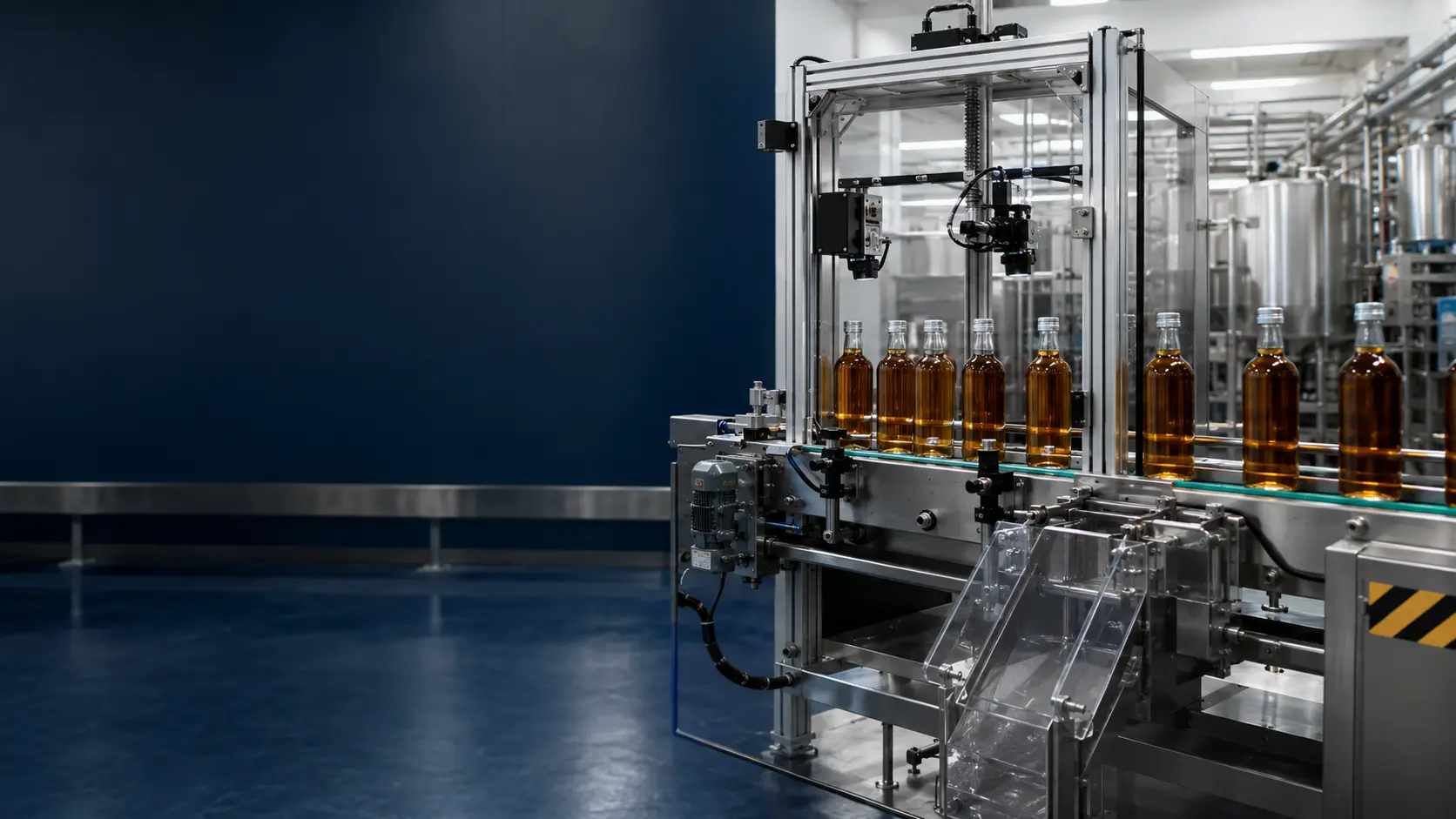
Feasibility brief
Samples should represent the full operating range rather than only clear, settled product from a laboratory bench.
Technology routes
No single sensing method is best for every foaming liquid. The useful distinction is whether the real fill can be observed or inferred consistently at production speed.
Suitable where a repeatable liquid or foam boundary remains visible through the container.
Assessed where foam, decoration or opaque packaging makes the optical boundary unreliable.
Uses pack mass when quantity control matters more than the physical height of the moving liquid.
Practical answers
Final tolerances are confirmed using real samples, production speeds and the expected range of product behaviour.
Ask an engineerSometimes. The image may allow liquid and foam boundaries to be treated separately, but performance depends on contrast, bubble structure, container optics and how consistently the product behaves at the inspection point.
Extra settling distance can help, but it must be balanced against available line space and reject location. Testing identifies whether distance materially improves separation between good and failed fills.
Usually each product and pack combination needs its own validated recipe because the boundary, foam behaviour and acceptance region may differ. Recipe selection can be linked to line changeover controls.
Common causes include product temperature, carbonation, filler behaviour, wet or dirty containers, ambient light, conveyor disturbance, wrong recipes and changes in bottle or label material.
Talk to Oxford Vision Systems
Foam behaviour changes with elapsed time after filling. Two lines with the same distance between filler and camera can present different product conditions if they run at different speeds. Record the time from filling to inspection during normal production, along with any accumulation or stops, instead of relying on conveyor distance alone.
As an initial planning calculation, travel time equals distance divided by conveyor speed when movement is continuous and the product follows the belt. Use consistent units and treat the result as an estimate; curves, transfers and queues can change the actual journey. Review a production video to identify the condition seen by the sensor at the fastest and slowest intended operation.
Also include the first containers after a line stop. They may have had longer to settle than the products that follow them, which can change the apparent boundary without a change in quantity. A representative trial should distinguish that acceptable behaviour from true underfill or overfill. Send a short sequence showing steady running, a normal pause and restart so the inspection-point review reflects the real bottling process.
The elapsed settling time also depends on conveyor speed, accumulation and stops.
Yes. Containers held during a pause may have a different foam condition from those inspected during steady running.
Prepare a fill-level inspection brief Review fill trends alongside process conditions